1st Beijing Physics, Astrophysics and Cosmology Workshop (B-PAC)

Asia/Shanghai
ICTP-AP

ICTP-AP

No.80 Zhongguancun East Road, Haidian District, Beijing 100190, China Building 7, Room 401
Andrew Miller (ICTP - AP / University Chinese Academy of Sciences), Verónica Vázquez-Aceves (PKU / KIAA)
Description

This meeting aims to bring together Beijing-based scientists that are working on physics, astrophysics and cosmology. It hopes to foster new collaborations and create a network of physicists working in Beijing.

Topics of interest include, but are not limited to:

  • Gravitational waves
  • Dark matter
  • Neutron stars
  • Black holes
  • Primordial black holes
  • Particle physics


We welcome participation from all members of the community, and especially from early-career scientists. This meeting will feature two presentations, lunch and a discussion session. We have invited:

  1. Pau Amaro Seoane (Universitat Politècnica de València)
  2. Mai Qiao (ICTP-AP)


To confirm your attendance, please register at the link.
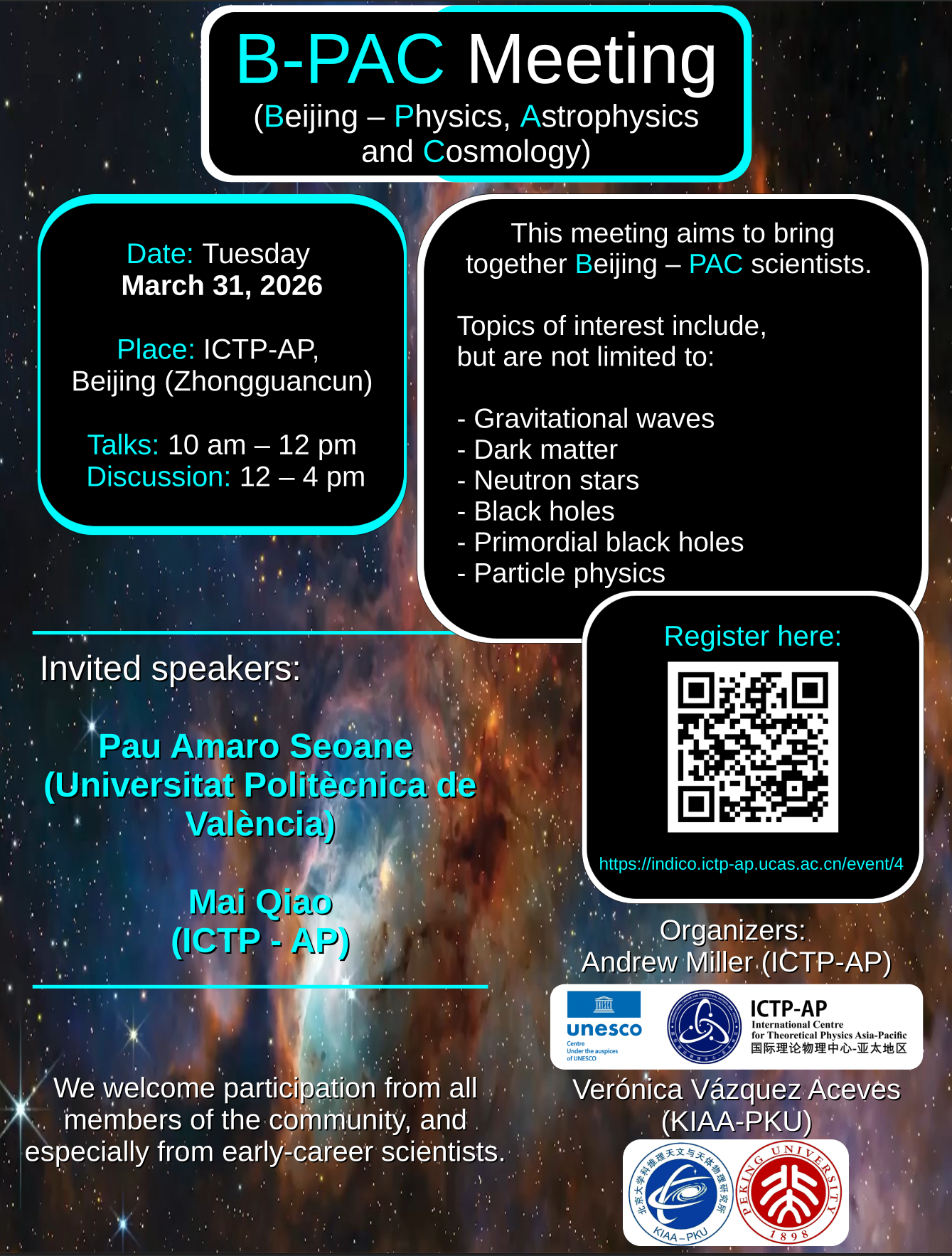


Registration
1st B-PAC Registration
    • Registration
    • Welcome
    • 1
      A forest of gravitational waves in our Galactic Centre

      The Galactic Centre contains populations of stellar-mass and
      substellar-mass compact objects orbiting the central black hole,
      classified as early extreme-mass ratio inspirals (E-EMRIs) and extremely
      large mass ratio inspirals (XMRIs). These systems constitute asymmetric
      binaries, characterized by mass ratios exceeding 10,0000 to 1. This mass
      differential causes the secondary body to approximate a test particle,
      completing tens of thousands or millions of orbital cycles prior to
      coalescence. This high cycle count delineates the spacetime geometry and
      multipolar structure of the central black hole with greater resolution
      than comparable-mass supermassive black hole binaries, which undergo
      rapid coalescence and exhibit fewer in-band cycles. The prolonged
      orbital data can in principle also facilitate topological analysis. By
      applying the Gauss-Bonnet theorem, the accumulated orbital precession
      parameters relate the integrated curvature of the spacetime to its
      topological invariants. The continuous gravitational wave emission from
      these populations generates a non-Gaussian, non-stationary composite
      signal within the frequency band of the Laser Interferometer Space
      Antenna. This aggregated signal comprises an incoherent superposition of
      individual waveforms from eccentric and circular orbits, which
      superimposes upon the spectral signatures of other target sources,
      including binaries of supermassive black holes and verification
      binaries. Spectral analysis indicates that sources with minimal
      frequency drift constitute an unresolved stochastic background, while
      systems with measurable frequency evolution produce distinct spectral
      components. Extracting targeted signals from this composite data
      requires time-frequency domain modeling and non-Poissonian statistical
      subtraction protocols.

      Speaker: Prof. Pau Amaro Seoane (Universitat Politècnica de València)
    • 11:00
      Break
    • 2
      Probing New Physics through Gravitational Wave Detection and Dark Matter Direct Detection

      Numerous astrophysical observations indicate the existence of dark matter via gravitational effects, yet its nature remains elusive. Experiments exploring non-gravitational interactions between dark matter and Standard Model (SM) particles include indirect, direct, and collider detection. Meanwhile, gravitational-wave (GW) observations of compact binary coalescences since GW150914 also offer valuable opportunities to both probe the early Universe and DM interactions. This talk covers three diverse topics: ultralight DM (ULDM) searches with LIGO data, correlated noise in stochastic gravitational-wave background (SGWB) studies, and MeV-scale light DM detection strategies. Specifically, we discuss ULDM detection using new LIGO data via the cross-correlation, Band-Sampled Data excess power (BSD), and Logarithmic Power Spectral Density (LPSD) methods. Regarding correlated noise, we address strategies to estimate its impact on SGWB research by monitoring magnetic field couplings with GW strain channels. Finally, for light DM, we present constraints on effective operators via cosmic-ray boosted DM (CRDM) with LZ data and analyze potential diurnal modulation effects in underground ionization signals caused by the Earth attenuation.

      Speaker: Dr Mai Qiao (ICTP - AP / University Chinese Academy of Sciences)
    • 12:30
      Lunch
    • Discussion
      Conveners: Andrew Miller (ICTP - AP / University Chinese Academy of Sciences), Veronica Vazquez-Aceves