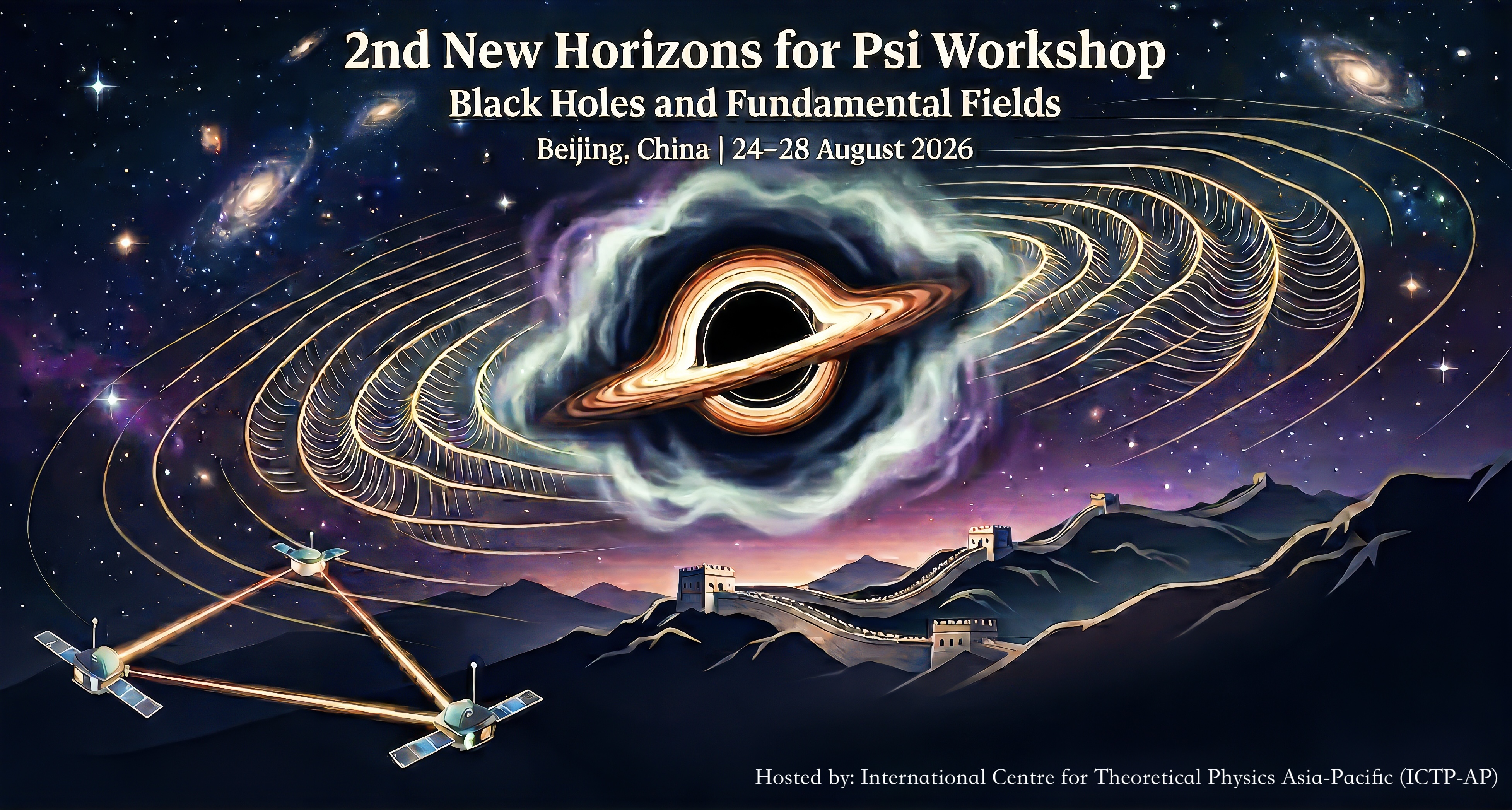
-
Enrico Barausse24/08/2026, 09:00
Gravitational waves offer a new probe of gravity and its dark sector,
Go to contribution page
from compact-binary strong fields to the ultralight degrees of freedom
that may constitute dark matter. I will review how non-linearities can
screen non-tensorial polarizations on solar-system scales in effective
field theories of dark energy, and present fully relativistic
simulations — in 1+1 dimensions (stellar... -
Richard Brito (CENTRA, Instituto Superior Técnico, Lisbon)24/08/2026, 09:30
Future space-based gravitational-wave observatories will open a unique avenue to study the environments surrounding black holes, in particular through the detection of extreme mass-ratio inspirals. In this seminar I will discuss the dynamics and gravitational-wave signatures of extreme mass-ratio inspirals evolving in scalar cloud environments — bosonic condensates that can grow around...
Go to contribution page -
Giovanni Maria Tomaselli24/08/2026, 10:30
Ultralight bosons can be produced by rotating black holes through superradiance, forming so-called "gravitational atoms". When these are part of a binary system, they give rise to a rich phenomenology. In this talk, I focus on two distinct scenarios. First, for an inspiralling compact binary, I show that the combination of infinitely many resonances and the "ionization jumps" creates a smooth...
Go to contribution page -
Andrea Maselli (Gran Sasso Science Institute)24/08/2026, 11:00
Asymmetric binaries, such as extreme- and intermediate-mass-ratio inspirals, are prime targets of future gravitational-wave detectors and offer a unique opportunity to probe the astrophysical environments in which such binaries evolve, as well as to test possible deviations from general relativity. To date, these two classes of effects — beyond-vacuum environmental physics and beyond-GR...
Go to contribution page -
Gilad Perez25/08/2026, 09:00
-
Diego Blas (ICREA/IFAE)25/08/2026, 09:30
I will present GUEST, a current proposal showing how satellite laser ranging of two tests masses in properly chosen orbits may be sensitive to GWs backgrounds/events in the microHz band at levels where one expect signals from different phenomena.
Go to contribution page -
Xiaojun Bi (Institute of High Energy Physics, Chinese Academy of Sciences)25/08/2026, 10:30
Ultralight dark matter (ULDM) has attracted significant attention as a compelling alternative to cold dark matter, yet it faces increasingly stringent constraints from observations of compact stellar systems and satellite galaxies. In this talk, I present a series of numerical simulation studies from our group that systematically reexamine these constraints. We first show how the almost-dark...
Go to contribution page -
Chen Sun (HIAS-UCAS)25/08/2026, 11:00
Many well-motivated UV theories contain bonsonic light degrees of freedom, which can exhibit various wave-like behaviors at low energy. This leads to many new ideas and novel observables in recent years to probe new physics in astrophysical and laboratory setups alike. In this talk, I will briefly review a few examples in leveraging the wave-like features to test axions and ultralight dark...
Go to contribution page -
Eugene Lim26/08/2026, 09:00
-
Haipeng An (Tsinghua University)26/08/2026, 09:30
I will discuss the vacuum decay processses that may happen in the early universe and the properties of the corresponding gravitational wave signals.
Go to contribution page -
Shao-Jiang Wang (Institute of Theoretical Physics, Chinese Academy of Sciences)26/08/2026, 10:00
In this talk, I will introduce our recent progress on cosmological first-order phase transitions, primordial black holes, scalar-induced gravitational waves, and sound waves from gravitational instability.
Go to contribution page -
Shaaban Khalil26/08/2026, 11:00
-
Volodymyr Takhistov (High Energy Accelerator Research Organization (KEK))26/08/2026, 11:30
-
Hyungjin Kim27/08/2026, 09:00
In this talk, I will discuss stochastic fluctuations of wave dark matter. I will discuss what it means and how we can utilize such stochastic density fluctuations of wave dark matter to probe its existence only via gravitational interaction. I will discuss a few specific observational and experimental setup, including inteferometry, pulsar timing, astrometry, and interplanetary range measurements.
Go to contribution page -
Arianna Foschi27/08/2026, 09:30
Sagittarius A is the closest supermassive black hole to Earth, and its proximity has allowed us to study its environment in remarkable detail. Specifically, the GRAVITY instrument can measure the motion of stars orbiting around it with exquisite precision, from which we can derive constraints on its environment. In this talk we review the main results on mass distributions around SgrA, from...
Go to contribution page -
Rodrigo Luís Lourenço Vicente27/08/2026, 10:30
Gravitational-wave (GW) observations allow us to reconstruct the orbital dynamics of compact binaries with remarkable precision. When these systems evolve in dense environments—such as active galactic nucleus discs, nuclear star clusters, or dark matter structures—their surroundings can leave characteristic imprints on the GW phase evolution. These imprints open a new avenue for probing not...
Go to contribution page -
Hai-Bo Yu27/08/2026, 11:00
-
27/08/2026, 16:00
-
Jing Ren28/08/2026, 09:00
Ultralight axion‑like dark matter (ALDM) is a well‑motivated candidate whose wave‑like nature is manifest on astronomical scales. Pulsar timing arrays (PTAs) and pulsar polarization arrays (PPAs) offer complementary probes: PTAs search for ALDM imprints on pulse arrival times, while PPAs target linear polarization angle rotations induced by the axion–photon Chern–Simons coupling. In this talk,...
Go to contribution page -
Hidetoshi Omiya28/08/2026, 09:30
In recent years, black hole superradiance, extraction of energy and angular momentum from a rotating black hole, has attracted considerable attention as a probe of light bosonic particles.
Go to contribution page
For a massive bosonic field, superradiance can lead to an instability and the growth of a macroscopic boson cloud, which may subsequently emit gravitational waves.
The cloud is often said to be seeded by... -
Nils Siemonsen28/08/2026, 10:30
Gravitational and electromagnetic signatures of black hole
Go to contribution page
superradiance are a unique probe of ultralight particles that
are weakly-coupled to ordinary matter. I will highlight the importance
of such non-minimal couplings as well as self-interactions
on observational signatures and present recent constraints on these
particles obtained from gravitational wave data. -
宏 Hong 张 Zhang (山东大学 Shandong University)28/08/2026, 11:00
An ultralight real scalar field could form a localized condensate under gravity, either with an external gravitational field such as the boson cloud around a black hole, or with self-gravity such as a boson star. Different from the complex scalar field, the real scalar cannot form vortices. Then how does the localized condensate take angular momentum? In this talk, I will explain the...
Go to contribution page
Choose timezone
Your profile timezone: